Thursday, January 20, 2011

"O this learning, what a thing it is!"

This past Monday, January 17th, I had the chance to attend another Education event at the ASC. Guest lecturer Ryan Nelson, Digital Manager for Globe Education in London, was in Staunton to talk about some of his recent work. He discussed the importance of creating an interesting and entertaining education website for a place like the Globe Theatre, as well as the multitude of ways he went about coming up with and designing digital resources for teaching and research. “Participation through engagement” is the goal, as Nelson put it. And, as someone new to working in the realm of education, only just discovering the various ways of making the past relevant and, well, as cool to everyone else as it is to me, all of these projects struck me as ridiculously exciting.


The Globe Theatre, London

As part of his talk, Nelson walked through some elements of the Globe Education website. These ranged from the more scholarly to the more entertaining; from the basic to the fantastic, and all of which can be found at http://www.globe-education.org/. On the more scholarly end of things, you can browse through an archive of conference and lecture papers, like those from the 2006 Theatre History Seminar on the use of blood on the stage, where you can learn the history behind the nifty trick, “To cut off ones head, and to laie it in a platter” (always useful). Or you can peruse research bulletins, which act essentially as production diaries for some of the first shows staged at the new Globe and which also include some wonderful detail on the historical research and rehearsal processes of a play, as well as actor interviews (one actor from a 2002 production of The Golden Ass notes: if you’re a man playing a woman, it’s more than just “put on a funny voice and get on with it” – never walk in straight lines or show your thumbs).

On the more purely entertainment end of things, you can “adopt an actor,” which does not, as Nelson was quick to point out, mean that a member of the Globe’s company comes and lives at your house. Instead, it means that students can sign up to access exclusive blogs and podcasts from certain actors during a season. It’s a great way to get a close look at all the behind-the-scenes action of a Shakespearean-era playhouse (for example, Lady Macbeth likes to unwind with a glass of bubbly after a show). Probably my favorite site, however, was that for “Playing Shakespeare.” Although aimed at young people in London schools, it was a shameless blast for me as well. This section is all about interaction, featuring several of the Globe’s recent productions, including Macbeth, Romeo and Juliet, and Much Ado about Nothing. There are audio and video clips, and interactive texts with an automatic, pop-up glossary. You can also alternately view these select scenes as the original script or as the director’s edit. Nelson spoke about his hopes to expand this part of the Education website in particular, ideally to a point where different groups could edit and manipulate play texts for different purposes. He referred to it as creating “a modern prompt book.” This stuck with me, since part of my ASC research has included researching cue scripts and prompt books. Listening to Nelson, I found myself thinking that it is a strange and wonderful thing to compare this idea of a contemporary prompt book, able to be created digitally through instantaneous re-crafting of these centuries-old written words, to the original, carefully copied and compiled prompt books of early modern theatre. They are two so entirely different methods for accomplishing the same purpose, and it is tempting to imagine the original members of the Lord Chamberlain’s Men or the Admiral’s Men loving and thoroughly appreciating this concept.

Also within “Playing Shakespeare” is a “social network” mock-up (otherwise known as that word starts with “face” and ends with “book”), where characters from the plays have their own profiles, complete with “O wall, o sweet, o lovely wall.” Finally, students can post their own opinions on themes and issues of the different plays, where, Nelson joked, the students often discuss the weighty topics more civilly than adults. Browsing through this section of the website myself, it was satisfying to see the high number of posts under each category and to picture these youngsters voluntarily engaging in discussion and getting excited about the ideas presented. And they had some insightful things to say, too. About Much Ado about Nothing, one student stated, “I enjoyed the book even more because the type of things that occur in the play happen a lot in my age group or high school. So many emotions such as love, hate, jealousy, and justice occur at my school so therefore many people can relate.” Another student’s advice is rather more straightforward: “Watch the DVD.”

The main page of the Globe Education website claims to provide “Resources for people passionate about learning and engaging with Shakespeare’s plays.” What jumped out to me in this statement were the words “engaging with.” Before coming to work here, I had never made that unlikely connection between Shakespeare and the internet, and how critical the latter could be in promoting the former. As I continue to plug away at my own project, that oft-mentioned “Rehearsal Tools of the ASC,” I’m discovering that what makes this process so satisfying for me is that I am creating an educational resource for others while, at the same time, learning new things myself on a daily basis. And that’s not just new things about Shakespeare and early modern theatre, but new things about the role of an Education Department in places like this and the Globe. I left this talk feeling enthused and inspired to persevere with my own small contribution to the ASC’s website.

“I am weak with toil, yet strong in appetite” (Cymbeline, 3.7.10).

Natalie A.

P.S. Two other organizations which Nelson referenced as being at the cutting edge of digital education were the Royal Opera House and the Tate Gallery – I leave you to check out these websites for yourself, as the wealth of material to peruse at each is astounding and beyond the scope of this entry.

Friday, January 7, 2011

New Year, Old Shakespeare

Happy New Year to one and all! Here’s to that renewed spirit and energy which comes with each new January, and which may be inspiring you to proclaim, “The day shall not be up so soon as I / To try the fair adventure of tomorrow” (King John, 5.5.21-22). Of course, with the new year also comes the customary resolutions to be healthier, happier, more productive, more successful, smarter, more well-read, etc. etc. But don’t get overwhelmed by such lists. Instead, why not get started on the latter two of those goals, at least, by learning some more about Shakespeare? And don’t be intimidated! You could start with something light and fun, for instance, like clothes.

I’ve lately been writing about the use of costumes in Shakespeare’s plays. One of the most interesting elements of this process has been the discovery that early modern plays were costumed with early modern clothing; there was little attempt to recreate an elaborate look and feel of the past. Instead, Julius Caesar, Timon of Athens, and King John alike all wore fashionable, 16th century garb. This means that, in the process of researching Elizabethan theatrical costumes, I’ve had to learn a lot about everyday Elizabethan dress. One fun way to get the basics of women’s dress of the time is to have a look at Cecily, the Elizabethan online paper doll at ElizabethanCostume.net, which has a plethora of other interesting info on Renaissance clothing. This is an entertaining way to keep your “farthingales,” “petticoats,” “kirtles,” and “bumrolls,” straight. Try to dress her inaccurately, though, and you’ll get a message like this: “My fitted kirtle looks passing strange when worn over a gathered petticoat; it doth not fit smoothly and evenly over so much petticoat fabric. Remove my petticoat ere dressing me in a kirtle.” This is serious business.

This past summer, I had my own up close and personal experience with early modern clothing, when I volunteered at the Bata Shoe Museum in Toronto, Ontario. Their special exhibition at the time was entitled “On a Pedestal: From Renaissance Chopines to Baroque Heels,” and the stars of the exhibit were several pairs of these wildest of Renaissance shoes. If you think today’s high heels are brutal, imagine wearing a pair of these! They were especially popular in Italy, where women would wear them hidden beneath their gowns to elongate their figures and display their social status. As you might imagine, the women also needed servants to accompany them everywhere they went in order to make sure they didn’t take an embarrassing tumble.

Shakespeare himself provides a testament to just how tall these shoes were in Hamlet, when Hamlet exclaims, “By’r Lady, your ladyship is nearer to heaven than when I saw you last by the altitude of a chopine” (2.2.424-426). In this case, Hamlet is addressing a member of the troupe of players who have come to Elsinore – a boy whose recent growth spurt is, apparently, equivalent to the height of a chopine (a fact which could prove problematic should he be needed to play a “ladyship”).

And while you may think the clothing of Shakespeare limited to crazy footwear and ridiculous ruffs, there are several ways in which he can still be quite fashion forward today. I recently stumbled across a blog entitled Mad Shakespeare, which offers some possible fashionable ensembles inspired by Shakespeare’s works, including Julius Caesar, Twelfth Night, and Othello.

The author of this blog mentioned that she used a site called Polyvore to create these outfits; this piqued my curiosity and inspired me to check out Polyvore myself, where I couldn’t resist creating my own Shakespeare-inspired look.
Macbeth
This one is my visual interpretation of Macbeth, with a distinct nod to the famous lady of that play. It had to, naturally, include some plaid, and I wanted to create a strong, empowered look with the high boots and wide belt. Some fur, in this case on the bag, seemed essential for the wild northern reaches of Scotland. And there was no way I could pass up those knife earrings. So, whether it be through fashion of the 16th or 21st century, the imagery of Shakespeare’s texts may be understood and interpreted in a variety of ways. (I’d love to see some other people’s outfit creations!)

See, you’ve already achieved a New Year’s goal; Shakespeare is a terrific resource for learning all sorts of new things. Now, you should probably make some cookies to celebrate (that whole “healthier” resolution can wait, right?).

Natalie A.

Tuesday, December 21, 2010

Eat, drink, and be merry!

“Some say that ever ‘gainst that season comes
Wherein our Saviour’s birth is celebrated,
This bird of dawning singeth all night long,
And then they say no spirit dare stir abroad,
The nights are wholesome, then no planets strike,
No fairy takes, nor witch hath power to charm,
So hallowed, and so gracious, is that time.”

So said Shakespeare about Christmas in Hamlet, 1.1. And, in this quote, we get a perfect snapshot of that combination of Christian and pagan traditions which were and still are so prevalent in the celebration of this holiday. In Shakespeare’s day, celebrating the Saviour’s birth didn’t necessarily mean you were off the hook when it came to the charms of fairies and witches. For, just like Halloween, the celebration of Christmas on December 25th has its origins in pre-Christian festivals. In pagan Britain, the end of December marked the winter solstice, when the longest, darkest days of winter were past. Naturally, this required some partying and feasting. Later, when Christianity arrived on the scene, Easter was, in fact, the primary holiday of the year. It wasn’t until the fourth century that church officials decided to institute a holiday to celebrate the birth of Jesus. The only problem was the Bible does not specify any particular date as Jesus’ birthday. And, while sometime in spring would have made the most sense (given the whole shepherds watching their flocks thing), the end of December was chosen in order to absorb the pagan winter solstice activities. By the end of the sixth century, Christmas had made its way successfully to England, and the rest is history.

This holiday season is connected to winters of centuries ago though one especially unique link: this was the first time that a lunar eclipse has fallen on the winter solstice since 1638. In honor of this extraordinary event, I thought I’d promote some Shakespearean Christmas festivities. So, for those who are tired of the stresses of 21st century holiday shopping or listening to “Grandma Got Run Over by a Reindeer” for the umpteenth time, here are some alternatives.
The Earth’s shadow blankets the moon during this year’s rare lunar eclipse.

Everything you need to know to have a very merry Shakespearean Christmas:

Old Saint Nick and Other Traditions: The original Santa Claus was really a monk named Nicholas, who was born in third century Turkey. Renowned for his kindness and generosity and for giving away all his worldly goods, Nicholas became a very popular saint, particularly during the Renaissance. However, the image of him as a rotund, jolly gift-giver didn’t come along until much later. Instead of mourning the lack of Santa, though, you could appoint a Lord of Misrule for the duration of the holiday. Duties of the Lord of Misrule include presiding over the revelries, handing out gifts, devising entertainments, and calling people silly names. The Yule log was another common tradition of the time. In Elizabethan England, the Christmas season ran for twelve days, from Christmas Eve on December 24th to Epiphany on January 6th. The Yule log was brought into the house on Christmas Eve and was meant to burn throughout all twelve days.

Decorations: Can you have a Christmas tree? Sure, why not. Long before people brought trees into their homes for the holidays, evergreens of all sorts were seen as reminders of the life that would come again in the spring. As a bonus, hanging evergreen boughs over your door was believed to keep away ghosts and evil spirits during the winter. Germans are believed to have chopped down the first Christmas trees in the sixteenth century, and legend has it that Protestant reformer Martin Luther was the first to add lighted candles to the tree, a pre-cursor to our modern Christmas lights. (If you try this, make sure to keep a fire extinguisher handy.) Although in Elizabethan England you would be well ahead of your time, since Christmas trees didn’t make their way there until the German Prince Albert married Queen Victoria in 1840.

Christmas Revels: Favorite activities, which haven’t changed much over the years, included feasting, dancing, game playing, and storytelling. You could play the slightly harrowing game of “snapdragon,” which involves taking turns picking raisins out of a dish of flaming brandy and popping them in your mouth. And then, of course, there’s wassailing. The word “wassail” comes from the Saxon “wachs heil,” meaning “I give you health.” In towns and villages across England, groups would go from house to house singing songs and carrying empty cups which the master of the house was meant to fill with spiced ale, along with providing snacks such as cakes and cheese. If you wish to revive this tradition, some Elizabethan carols you could sing include the ultimate wassailing song, “Here We Come A-Wassailing.” Others which might be familiar to the modern listener are “I Saw Three Ships” (the ships in this traditional English folk song refer to the vessels bearing the supposed skulls of the three wise men to a cathedral in Cologne), “The Twelve Days of Christmas” (legend has it that this song was written for parents to pass on Catholic symbols to their children after Henry VIII supplanted Catholicism with the Church of England), and “The Holly and the Ivy” (both of which commonly festooned Elizabethan houses at Christmastime).

Refreshments: A mouthwatering picture of what graced the Elizabethan Christmastime table may be seen in Thomas Tusser’s 500 Points of Husbandry, published in 1573:

“Good husband and huswife, now chiefly be glad,
Things handsome to have, as they ought to be had.
They both do provide, against Christmas do come,
To welcome their neighbors, good cheer to have some.
Good bread and good drink, a good fire in the hall,
Brawn, pudding, and souse, and good mustard withal.
Beef, mutton, and pork, and good pies of the best,
Pig, veal, goose, and capon, and turkey well drest,
Cheese, apples and nuts, and good carols to hear,
As then in the country is counted good cheer.
What cost to good husband, is any of this?
Good household provision only it is:
Of other the like, I do leave out a many,
That costeth the husband never a penny.”

To try some of these recipes yourself, consult HistoricalFoods, which is quickly becoming one of my favorite websites. They have a recipe for that British Christmas staple, plum pudding, as well as one for authentic wassail.

Merry Christmas,

Natalie A.

PS. For some extra Shakespearean holiday humor, read about why Shakespeare hated Christmas (who knew?). Or check out these hilarious letters to Santa by Shakespearean characters. (Warning: rated PG-13!)

Thursday, December 9, 2010

Centuries of Shakespeare

It is, of course, an oft repeated fact that Shakespeare’s plays have been performed, in some form, continuously since his death. For many years, however, there was a gap in my brain between the days of the man himself and the performance of his works today. My mind glossed over all those intervening centuries. Instead, there were only two Shakespeares: that of the Elizabethan era and that of modern theatre. Recently, I have begun to consider Shakespeare in other decades, and it has opened a whole new window into the past. It is especially fascinating to see how the art of early photography was used to document the theatre, and there is some magic element in seeing antique photographs from productions of these already-historic works. It is, essentially, a double layering of history upon history.

The Cleveland Press, part of the Cleveland State University Library, has an incredible photographic archive of Shakespeare in performance, and browsing through their collection was part of what piqued my curiosity in this heretofore unconsidered facet of Shakespeare. The oldest photograph which the Cleveland Press has is of stage actor Lawrence Barrett as Cassius in an 1870 production of Julius Caesar.

Barrett, looking very Roman as Cassius.

Looking at this photo led me down a new path of investigation, when I read that Barrett starred in this particular show alongside fellow actor Edwin Booth as Brutus. Now, Booth was perhaps the most famous Shakespearean actor of the nineteenth century. One of the biggest stars of his day, he was famous for his Hamlet, Richard III, and Shylock. Unbelievably, a wax cylinder recording of him performing Othello survives. Although the sound quality is poor, it’s spine tingling to hear this voice speaking from over a hundred years in the past, utilizing Shakespeare as the medium to reach across the intervening century.

Edwin Booth as Hamlet.

Edwin not only became famous as a player of Shakespeare but also became infamous as the older brother of John Wilkes Booth. That’s right – that’s the John Wilkes Booth, the assassin of President Abraham Lincoln. In fact, John Wilkes himself had appeared onstage several times before his most famous performance at Ford’s Theatre. Only that previous fall of 1864, he, Edwin, and their brother Junius had acted together in Julius Caesar as Marc Antony, Brutus, and Cassius, respectively. Edwin disowned his brother after the assassination and was himself forced to retire from the public eye for several months. It did not incur any lasting damage to his reputation, however, as he is still lauded and respected today as a master of the theatre.

The brothers Booth: John, Junius, and Edwin in Julius Caesar.

The Cleveland Press collection also contains a photograph of Sarah Bernhardt, possibly the most famous female actress of the nineteenth century.

The glamorous Bernhardt as Cleopatra in Antony and Cleopatra, around 1890.

This compelling picture spurred me on to learn that Bernhardt later made her film debut in 1900 in Le Duel d’Hamlet, a brief two minute reel of Hamlet’s duel with Laertes in which she played the title role. This is believed to be first ever film adaptation of that play, and it is also noted for utilizing the new innovation of playing pre-recorded cylinders of the actor’s voices and sound effects along with the film. The entire film may be seen here, unfortunately without the soundtrack, which has been lost.

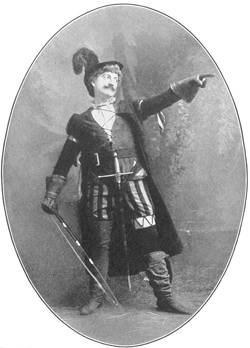
Drew strutting his stuff as Petruchio.

Or check out this dapper fellow, John Drew, Jr., another famous nineteenth century Shakespearean specialist. Drew came from a family of actors and is the uncle of John, Ethel, and Lionel Barrymore. This also means that he’s the great-great uncle of Drew Barrymore.

All of the photos in this collection are like breadcrumbs leading down a trail of interesting discoveries, as I realized once I began browsing through them. Each one uncovers all new stories of Shakespeare and the actors who have brought his words to life over the centuries. The costumes are so elaborate and the expressions so vivid that there is an instant connection across time, making the viewer regret not being able to see these theatrical giants in action. It is impossible not to look at a photograph without wanting to find out a little bit more about that actor, to imagine how they were celebrities in their own time and how their work is still influencing performances of Shakespeare today. For it is not just that Shakespeare of the Elizabethan theatre who has informed how his works are produced in the twenty-first century, but rather a series of building blocks of trends and innovations resting on the shoulders of these men and women and those who came before them.

Natalie A.

Tuesday, November 23, 2010

Shakespeare and...Thanksgiving?

Ah, Thanksgiving. That time of year for being with family and friends and for cooking ridiculous amounts delicious food…turkey and cranberries and sweet potatoes topped with globs of marshmallows and pumpkin pie! But is it possible to draw a connecting line between today’s epicurean extravaganza and foodie fetes in Shakespeare’s England? Absolutely. While Shakespeare wrote all of his plays well before the Plymouth colonists celebrated their first harvest with the Wampanoag Indians in 1621, giving birth to the Thanksgiving legend, the New World and its foods were no strangers to Elizabethans. And neither was the concept of a harvest festival. English harvest festivals abounded in the latter quarter of the Elizabethan calendar. November 11th marked the feast of St. Martin, and November 30th was the feast of St. Andrew, both denoting the end of the harvest season and the coming on of winter. On these days, Elizabethans would get together and stuff their faces, much as we do today.

In fact, a lot of what we consider traditional American holiday staples originated in England: stuffing the turkey with bread and dried fruit, apple pies, and even gingerbread houses. This is due to the intermingling of ingredients and cooking techniques which took place as Europeans explored the Americas and brought back various new items to their home countries, putting their own unique spins on them. The first turkeys arrived in England in the early sixteenth century by way of Spanish traders from the New World. These birds caught on quickly, being larger than the chicken and tastier than the swan or the peacock. Tomatoes, potatoes, chili peppers, maize, beans, pumpkins, coffee, and chocolate, to name just a few, were some of the other imports. Furthermore, spices such as ginger, cinnamon, and mace had previously arrived in England during the Middle Ages, brought from the east by crusaders.

Indeed, you could say that Shakespeare was living during a pretty gastronomically exciting time. Elizabethans were taking full advantage of the spice trade, comparatively new in the history of the country, and now they also had a plethora of new products flowing in from the New World with which to experiment. While there are definitely plenty of recipes from the time which seem less than appealing to our modern palettes, some don’t sound half bad. Take this recipe for baked quinces (a relative of the pear), for example, from A Book of Cookrye, published in 1591: “Core your Quinces and fair pare them, perboyle them in seething licour, Wine or water, or halfe wine and half water and season them with Sinamon and sugar, and put halfe a dozen Cloves into your Pyes amongst them, and halfe a dozen spoonful of rosewater, put in good of sugar. If you will bake them a slighter waye, you maye put in Muscadell to spare Sugar.” Mmm.

There are many food references in Shakespeare’s plays, often used in a metaphorical sense. Interestingly, the word “corn” appears in several of Shakespeare’s plays. In 2 Henry VI, Duchess Eleanor questions her husband, “Why droops my lord, like over-ripen’d corn” (1.2.1)? Yet, in these cases, Shakespeare was not actually referring to the American corn with which we are familiar. Instead, “corn,” in the early modern context, meant “grain.” In this sense, corn provides a useful metaphor in several scenes for striking down an enemy. A harvest reference appears in 3 Henry VI, when King Edward speaks of cutting down his enemies “like to autumn’s corn” (5.7.3). In Henry VIII, Archbishop Cranmer predicts of the infant Queen Elizabeth that her foes will “shake like a field of beaten corn” (5.5.31). And while there are numerous references to feasting in Shakespeare’s works, along with several feast scenes featured in the plays, when specific foods are mentioned it is usually by “low” or comic characters. The Clown in The Winter’s Tale, for instance, describes his grocery list for a feast as follows: “Let me see: what am I to buy for our sheep-shearing feast? Three pounds of sugar, five pound of currants, rice […]. I must have saffron to color the warden pies; mace; dates […]; nutmegs, seven; a race or two of ginger […]; four pounds of pruins, and as many of raisins o’ th’ sun” (4.3.36-49). Also, there are many more references to wine, beer, and other alcoholic beverages than there are to chewable foods. For a nifty collection of each and every reference to food of all sorts in Shakespeare, from almond to zucchini, take a look at this site.

So, while Shakespeare and his contemporaries might have missed out on the traditional American Thanksgiving – which was only established on its current date in 1941 – and the joys of fifteen pound turkeys, French’s green bean casserole, the Macy’s Thanksgiving Day Parade, and Black Friday, they were certainly familiar with the concept of coming together with those closest to them as the autumn drew to a close, enjoying the fruits of the harvest and celebrating with good food and good cheer. And Shakespeare, as he usually does, has some good advice to offer upon the occasion:

“O Lord that lends me life,
Lend me a heart replete with thankfulness.”
- 2 Henry VI, 1.1.19-20.

Natalie A.

PS. Should you want to try your hand at Renaissance cooking, HistoricalFoods.com offers recipes for “gilded marchpane” – a fantastical marzipan centerpiece favored by the Tudors – and even “buttered beere,” which I’ve been wanting to try since the first time Harry Potter sampled the stuff in Hogsmeade. And, if you wish to expand your horizons to the Stuart period, you can even try “roast wild boar,” “plague-water” (helpful for keeping away that pesky pestilence), and “toast of divers sorts.”

Friday, November 19, 2010

"Marvelous sweet music!"

In the course of my research, I frequently come across fun/entertaining/goofy items related to my current topic of investigation which, unfortunately, are not quite scholarly enough to incorporate into my educational writing for “Rehearsal Tools of the ASC.” Thus, I am discovering that this blog is the perfect outlet to share these random, bite-size bits and clips of information in a slightly less formal environment. Take, for example, what I have most recently been writing about: music. In searching out all there is to know on Shakespeare and music, I’ve become more and more aware of just how large a role this particular combination still plays in popular culture. A search for “Shakespeare” under the “Music” category on Amazon.com returns 884 results, encompassing everything from compilations of music popular in Shakespeare’s day to the Shakespeare in Love soundtrack; from Baby Einstein: Baby Shakespeare to Are You Shakespearienced? Heck, a person has only to turn on the radio to hear some toe-tapping Shakespeare. (A slightly different ending for Romeo and Juliet perhaps, but who hasn’t always wanted things to work out for those two, anyway?)

If one starts to pay attention, in fact, Shakespeare begins to turn up all over the place in music. Just listen closely to the lyrics in the Disney classic, Beauty and the Beast. In “The Mob Song” the evil Gaston encourages those torch and pitchfork wielding townspeople to “Screw your courage to the sticking place!” This is the same advice which Lady Macbeth offers her husband when he has second thoughts about their plot to kill King Duncan: “We fail? But screw your courage to the sticking place, and we’ll not fail” (Macbeth, 1.7.60-62). There’s an entire song in the hippie musical Hair based on Hamlet’s “What a piece of work is man” monologue (Hamlet, 2.2). And people still walk down the aisle to Mendelssohn’s “Wedding March” from his incidental music for A Midsummer Night’s Dream.

All this is not, however, a new phenomenon. Practically since Shakespeare’s plays were first staged, it seems that people have had a fascination with turning Shakespeare into music and adding music to Shakespeare. Composer Benjamin Britten said, “I feel that everyone ought to set Shakespeare to music in order just to get to know the incredible beauty and intensity of these words." In 1960, Britten himself turned A Midsummer Night’s Dream into an opera, which still enjoys popularity today. A trailer for the English Touring Opera’s Spring 2010 production, featuring Thisbe’s “Asleep, my love?” speech (A Midsummer Night’s Dream, V.i.319) may be seen here.

When it comes to the whole Shakespeare/music trend, though, one of my personal favorites has to be Kenneth Branagh’s movie musical of Love’s Labour’s Lost. Yes, it’s cheesy, and sometimes borders on the bizarre, but it’s also a lot of fun. Set in a 1930’s-inspired Navarre, it features such hits of that decade as Cole Porter’s “I Get a Kick Out of You,” Jerome Kern’s “The Way You Look Tonight,” and Irving Berlin’s “There’s No Business Like Showbusiness” (belted out by the always hilarious Nathan Lane as the clown Costard). Check out the film’s whacky rendition of Irving Berlin’s “Cheek to Cheek,” featuring Kenneth Branagh, Alessandro Nivola, Matthew Lillard, and Adrien Lester as the besotted Berowne, King Ferdinand, Longaville, and Dumaine, respectively, along with the objects of their affection.

Another 30’s-set, yet ever so slightly darker, Shakespeare is Ian McKellen’s Richard III, which plays out in an alternate universe Great Britain controlled by a fascist government. The movie opens cheerily enough, though, with Christopher Marlowe’s poem “The Passionate Shepherd to His Love” set to a swinging big band melody. The romantic, youthful tone of the lyrics provides a stark contrast to the dark, bitter mood Richard soon provides. In addition to Ian McKellen skulking about, keep an eye out also for Maggie Smith, Annette Bening, Jim Broadbent, and Robert Downey, Jr.

This is just a very (very, very) small sampling of some ways in which Shakespeare’s words have inspired a variety of musical outpourings. Some have been masterful…some not so much…and some have been just plain weird. But they have all entertained countless numbers of people – in addition to providing an entertaining diversion for me in the process of sorting through scholarly articles and primary sources. Shakespeare not only brought music to the stage in his day, but has since conquered Broadway and the pop charts, been turned into musical entertainment for the big screen and TV, inspired composers from Tchaikovsky to Stravinsky, and has spoken to almost every generation since his death through the musical medium. Pretty talented for a fellow who’s been dead for almost four hundred years…and who definitely never heard of Taylor Swift.

Natalie A.

Tuesday, November 9, 2010

A Festival of Theses!

On Monday, the 8th of November, I had the opportunity to attend the Fall Thesis Project Festival at Blackfriars Playhouse, where graduate students in Mary Baldwin College’s MLITT/MFA program in Shakespeare and Performance presented on their various research topics. A day-long “Thesis Festival” might not, at first, sound like a rollicking good time, but it proved to be a day full of very enjoyable and interesting presentations.

The subjects which were examined covered a broad range, providing a colorful bouquet of Shakespearean topics ready to be admired. There was everything from What to Expect When Staging the Expecting: Pregnancy in Early Modern Drama to Miranda as “Native”: An Exploration of Sexual Politics and Cultural Hegemony in Caribbean and African Postcolonial Adaptations of The Tempest to Rosalind and Cleopatra: The Androgyne in Performance, to name just a few. For a detailed account of each presentation, see the official ASC liveblogs of the event: Session 1, Session 2, and Session 3.

One which was particularly attention-grabbing to me was ‘SBlood, Zounds, and Marry: Oaths as Indicators of Character Change on the Early Modern Stage, presented by David C. Santangelo. While a word like “Zounds!” (a contraction of “God’s wounds”) may seem pretty tame to us today, four hundred years ago such an exclamation would have caused quite a stir in the playhouse. During his talk, Santangelo also examined the ways in which a character’s use of oaths within a play can reveal essential elements of his or her character. As an example he used Iago, whose oaths reveal in turn his crudeness and his cleverness throughout Othello. His exclamation, “By Janus” (1.2.33), for instance, is significant in that Janus is a two-faced god, just as Iago himself is a two-faced character.

Another entertaining presentation was Andrea Kelley’s If the Shrew Fits: Chronology, Misogyny, and Dichotomy in the Taming Plays. Kelley opened her talk with a hilarious YouTube video chronicling the transformation of various film Kates, including Elizabeth Taylor in a 1967 The Taming of the Shrew, Julia Stiles in 10 Things I Hate About You, and Shirley Henderson in a modern re-telling (see it here). She then discussed how different versions of this story are prevalent throughout history, but they don’t necessarily represent realistic marriages of their times, just as modern sitcoms don’t exactly portray accurate husband-wife relationships. Kelley used different texts on marriage from Shakespeare’s day through the middle of the 18th century to illustrate both the more romantic and the slightly harsher views on how to tame a shrew, so to speak. (One offered this endearing advice in oh-so witty rhyme form: “Rub a dub, kill her with a club.” Hmm.)

Of course, these are just two out of eleven; all of the theses were well-presented and engaging, whether they were on a topic I was interested in, only vaguely aware of, or knew absolutely nothing about. There was also X-Treme Casting, about the practice of using as few as five actors to put on a Shakespeare play, and Ford, and Jonson, and Middleton, Oh My!, which featured some hilarious performances by other students in the Mary Baldwin program as a geriatric John Ford and irascible Ben Jonson, among others, and which asked the question: Why do we study Shakespeare more than any of these other playwrights, anyway?

The high level of scholarship which is happening constantly in and around the American Shakespeare Center is something I was completely unaware of until I became an intern in the Education Department, and it is something which I believe the general public is largely unconscious of as well. I have found that, when I inform people that I am working as an intern at the American Shakespeare Center in Staunton, the typical response is, “Oh, you mean at Blackfriars?” The fact is that the Blackfriars Playhouse is a part of a larger, vital vehicle for sharing a love of Shakespeare and early modern theatre and for educating both scholars and the average citizen on this subject. This is something I am becoming more and more aware of as I work here. Unless a person is in-the-know in some way, they could see the Blackfriars Playhouse as simply a theatre. Of course, it is a theatre – and a great one! – but it is also a venue for the sharing of some amazing research, all of which is open and available to a curious public. One would absolutely not have to know a thing about Shakespeare and performance to have a great time at an event like the Fall Thesis Festival. There’s almost always some neat education event happening at Blackfriars. So don’t be intimidated – go check it out!

Natalie A.